
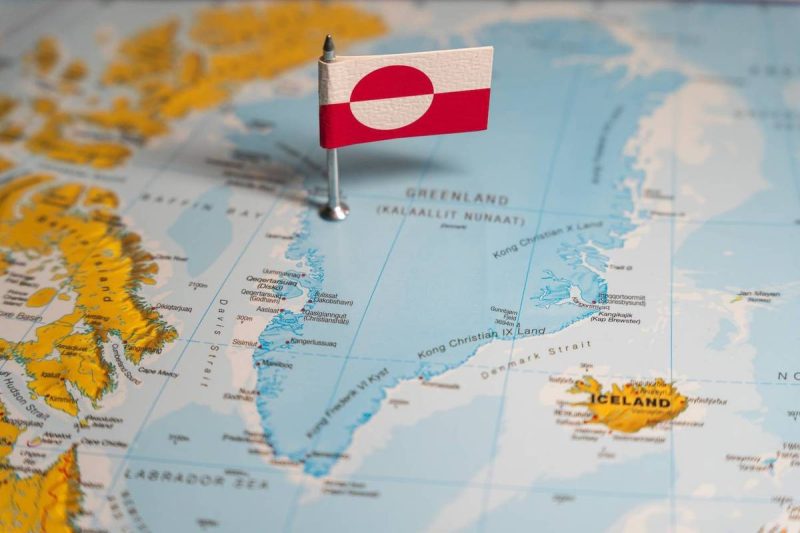
US President Donald Trump’s claim that Washington has reached a “framework of a future deal” over Greenland has raised more questions than answers, particularly over whether access to the Arctic territory’s vast natural resources and critical minerals is part of the discussions.
Trump’s recent announcement on his Truth Social platform after meetings at the World Economic Forum in Davos appeared to mark a de-escalation after weeks of mounting pressure on Denmark and Greenland.
Those tensions had included threats of tariffs and repeated suggestions that the United States might use force to secure control of the semi-autonomous Danish territory. Instead, Trump said the framework emerged from a “very productive meeting” with NATO Secretary General Mark Rutte and suggested talks would continue.
“This solution, if consummated, will be a great one for the United States of America, and all NATO Nations,” Trump wrote, offering no details on what the framework contains.
A mysterious and vague framework
What has followed has been a series of clarifications about what the deal does not include.
Danish Prime Minister Mette Frederiksen said Denmark is open to negotiations on security and cooperation but stressed that “we cannot negotiate on our sovereignty.”
Greenland’s Prime Minister Jens-Frederik Nielsen echoed that position, calling sovereignty a ‘red line’ and saying he was unaware of the substance of any framework being discussed.
NATO officials have likewise emphasized that the alliance has no mandate to negotiate territorial arrangements and that any talks would have to involve Denmark, Greenland, and the US directly.
Despite the lack of specifics, Trump’s comments have revived debate over why Greenland matters so much to Washington. Security considerations have dominated official statements, yet Greenland’s natural resources remain a central but unresolved part of the picture.
A resource-centric agenda
Despite the lack of specifics, Trump’s comments have revived debate over why Greenland matters so much to Washington. Security considerations have dominated official statements, yet Greenland’s natural resources remain a central but unresolved part of the picture.
Greenland is believed to sit on top of large reserves of oil and natural gas, though commercial extraction has yet to take off. The island is thought to host substantial deposits of minerals considered critical for modern economies and military technologies.
According to the 2023 Geological Survey of Denmark and Greenland, 25 of the 34 minerals classified as “critical raw materials” by the European Commission are found in Greenland, including graphite, niobium and titanium. These materials are essential for electronics, Trump himself has frequently linked Greenland to minerals and security in the same breath, arguing that US control would put the country in “a really good position, especially as it pertains to security and to minerals.”
At times, however, Trump has appeared to downplay the economic case, instead emphasizing geopolitical threats.
“I want Greenland for security – I don’t want it for anything else,” he told reporters at Davos. “You have to go 25ft down through ice to get it. It’s not, it’s not something that a lot of people are going to do or want to do.”
Even so, access to Greenland’s resources has loomed large in the background of the administration’s agenda. Trump has made countering China’s dominance in rare earths and strategic minerals a core economic and national security priority, placing supply chains at the center of US geopolitical strategy.
The US has been moving in that direction for years. In 2020, during Trump’s first term, Washington reopened its consulate in Nuuk, Greenland’s capital, as part of a broader effort to deepen ties amid expanding Russian and Chinese activity in the Arctic.
Since Trump returned to office, his allies have increasingly framed Greenland as a commercial opportunity as well as a strategic one, citing climate change-driven shifts that are opening new shipping routes and access to fisheries, energy, and mineral resources.
Shades of an existing agreement
For now, none of those ambitions have been reflected in concrete terms tied to Trump’s announced framework. NATO said only that future negotiations would aim to ensure Russia and China “never gain a foothold — economically or militarily — in Greenland.”
While that language could encompass mining and investment restrictions, it stops short of any commitment on mineral access or ownership.
According to a New York Times report, officials familiar with parallel discussions said one idea floated informally involved granting the US sovereignty or near-sovereign control over small areas of Greenland for military bases, modeled on Britain’s sovereign base areas in Cyprus.
Such an arrangement would address defense concerns but would do little to resolve questions about mineral rights, which are governed by Greenlandic law and subject to strong local political sensitivities.”
Trump’s shifting tone has also prompted scrutiny in Washington. When asked whether the framework met his earlier demand to “own” Greenland, Trump avoided the question, calling the arrangement “a long-term deal” that was “infinite” and “forever.”
Critics have noted that similar language already applies to the 1951 US-Denmark defense agreement, which allows an open-ended American military presence at what is now Pituffik Space Base.
Updated in 2004, the same agreement gives the US wide authority within its defense areas, including control over personnel, equipment, and movement. Some analysts argue that most of what Trump appears to be seeking could be achieved by revising or expanding that framework rather than pursuing ownership or sovereignty.
Whether the new framework goes further remains unclear. US, Danish, and Greenlandic officials are expected to continue talks in the coming weeks, and a working group could meet as early as next week to flesh out details.
Until then, the absence of explicit language on critical minerals stands out, given how often they have been invoked as a justification for Trump’s aggressive rhetoric.
Securities Disclosure: I, Giann Liguid, hold no direct investment interest in any company mentioned in this article.