
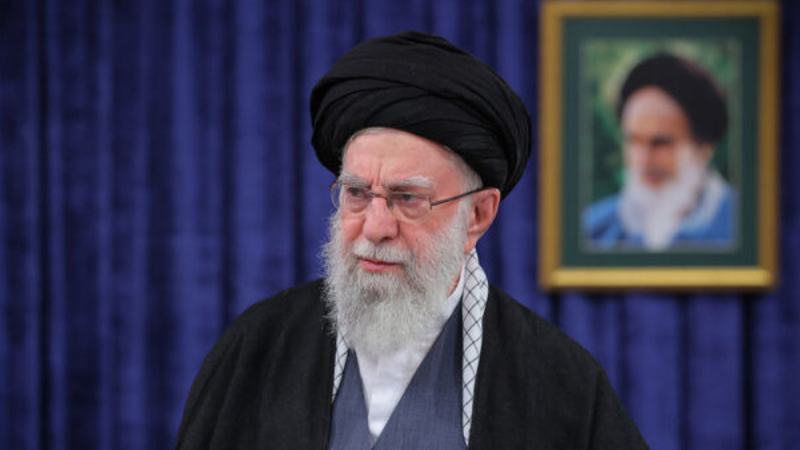
President Donald Trump said U.S. military strikes on Iran have eliminated much of the regime’s anticipated leadership succession bench, raising new questions about who will emerge to lead the Islamic Republic after the death of Supreme Leader Ayatollah Ali Khamenei.
‘Most of the people we had in mind are dead,’ Trump told reporters Tuesday. ‘So, you know, we had some in mind from that group that is, is dead. And now we have another group. They may be dead also based on reports. So, I guess you have a third wave coming in. Pretty soon we’re not going to know anybody.’
The president said the worst-case scenario would be someone taking over ‘who’s as bad as the previous person.’
‘That could happen,’ Trump said. ‘We don’t want that to happen. It would probably be the worse you go through this, and then, in five years, you realize you put somebody in who was no better. We’d like to see somebody in there that’s going to bring it back for the people, and we’ll see what happens with the people. You know, they have their chance.’
The remarks come as Israeli strikes hit the building in the holy city of Qom, Iran, associated with the country’s Assembly of Experts, the 88-member clerical body constitutionally responsible for selecting the next supreme leader, Israeli Defense Forces (IDF) spokesperson Effie Defrin confirmed to Fox News Digital.
‘We struck a few targets involved in terrorism,’ Defrin said.
Iranian media has claimed the building was empty at the time of the strikes. Israel does not yet have a battle damage assessment, Defrin said.
The White House has said 49 top Iranian leaders were taken out in the opening phase of the campaign, which Trump said put the operation ‘ahead of schedule.’
Defense officials, however, have stressed the operation was not designed to force regime change.
‘This is not a so-called regime change war,’ War Secretary Pete Hegseth said. ‘But the regime sure did change, and the world is better off for it today.’
That distinction now sits at the center of a critical geopolitical question: If the U.S. did not intend to overthrow Iran’s ruling system but has eliminated much of its top leadership and succession chain, what happens next?
How Iran’s succession process is supposed to work
Under Iran’s constitution, the Assembly of Experts selects a new supreme leader when the position becomes vacant. In the interim, a three-person council — composed of the president, the head of the judiciary and a senior cleric — carries out the leader’s duties until a permanent successor is chosen.
After Khamenei’s death, Iranian authorities moved to activate that constitutional mechanism. President Masoud Pezeshkian, judiciary chief Gholam-Hossein Mohseni-Ejei and senior cleric Alireza Arafi are overseeing the interim phase.
The structure is designed to prevent exactly the kind of vacuum that can destabilize authoritarian systems. But Trump’s assertion that multiple potential successors were killed has intensified uncertainty about whether Tehran’s clerical establishment still has a clear and viable path forward.
While Israeli officials have indicated that senior figures were targeted in recent strikes, Iran has not publicly confirmed a full list of clerical or succession-level casualties. The extent to which the Assembly of Experts itself was directly disrupted remains unclear.
Potential successors and reported losses
Judiciary chief Mohseni-Ejei has long been viewed as a senior insider within the succession framework and remains part of the interim leadership council.
Ayatollah Ali Khamenei had quietly begun preparing for a potential transition during last year’s 12-day war between Iran and Israel, according to prior reporting by The New York Times.
Possible successors reportedly included his chief of staff Ali Asghar Hejazi, Mohseni-Ejei and Hassan Khomeini, the grandson of Islamic Republic founder Ayatollah Ruhollah Khomeini.
Israeli officials have claimed Hejazi was killed in recent strikes, though Iranian authorities have not publicly confirmed his death.
Ayatollah Alireza Arafi has also been viewed by some analysts as a potential contender within the clerical hierarchy.
Trump’s claim that ‘second or third place is dead’ suggests U.S. intelligence assessed that multiple tiers of leadership were affected. However, no comprehensive public accounting of succession-ranking figures killed has been released.
Risk of power shifts
Some analysts warn that wiping out multiple tiers of leadership risks creating the kind of power vacuum that has destabilized other countries after the removal of entrenched rulers.
After Moammar Gadhafi was removed in Libya in 2011, rival militias and competing governments fractured the country. The U.S. invasion of Iraq similarly led to prolonged insurgency and regional upheaval.
Iran’s situation is not identical. The country retains formal succession rules, centralized institutions and a functioning state bureaucracy.
But if clerical leaders struggle to agree on a successor, competing power centers could emerge.
The Islamic Revolutionary Guard Corps (IRGC), which controls vast military, intelligence and economic assets, could move to consolidate influence if civilian religious leadership falters.
‘When clerics cannot agree, power does not disappear. It shifts,’ analysts at the Foundation for Defense of Democracies wrote in a recent assessment, warning that sustained instability could empower the IRGC. ‘The most likely beneficiary of sustained instability is the Islamic Revolutionary Guard Corps.’
Domestic unrest and opposition figures
Iran’s leadership already has faced intense domestic unrest.
Nationwide protests erupted in late December 2025 concerning economic hardship and political grievances, prompting a sweeping government crackdown. Trump has claimed 32,000 people were killed during the regime’s response, a figure significantly higher than official Iranian statements and independent estimates.
To stifle communication and hinder coordination among demonstrators, Iranian authorities imposed a near-total internet blackout during the unrest and again after the start of U.S. strikes.
Outside the regime, opposition figures have positioned themselves as potential transitional voices in the event of broader political realignment.
Reza Pahlavi, the exiled son of Iran’s last shah, has cast himself as a symbol of the opposition and a potential transitional figure who could steer Iran toward a democratic system if the clerical order collapses.
But Pahlavi lives in the U.S., and Trump said Tuesday someone within Iran might be more ‘appropriate.’
‘Some people like him, and we haven’t been thinking too much about that,’ Trump said. ‘It would seem to me that somebody from within maybe would be more appropriate. I’ve said that he looks like a very nice person, but it would seem to me that somebody that’s there that’s currently popular if there is such a person.’
Maryam Rajavi, president-elect of the National Council of Resistance of Iran — a coalition of exiled opposition groups led by the People’s Mojahedin Organization of Iran (MEK) — advocates for the overthrow of the clerical regime and establishment of a democratic republic.
Both figures have international supporters, but their actual influence inside Iran remains uncertain and contested.
Not regime change — but what is it?
Critics of U.S. intervention in the Middle East often point to past regime-change efforts that produced instability rather than stability.
Trump has instead pointed to Venezuela as a more relevant comparison.
In January, U.S. forces captured President Nicolás Maduro, and Vice President Delcy Rodríguez assumed power under Venezuela’s constitutional process. The country’s governing institutions continued functioning while Washington exerted influence through economic pressure, legal action over oil assets and diplomatic engagement rather than direct rule.
Trump told Fox News’ Bret Baier that the Venezuela operation was a template for leadership that ‘takes over’ and one the United States can work with, suggesting the administration sees a pathway where entrenched systems adjust under pressure rather than collapse outright.
Whether Iran follows that model — maintaining institutional continuity despite devastating leadership losses — or whether deeper fractures emerge inside the clerical establishment remains one of the most consequential unanswered questions in the Middle East.